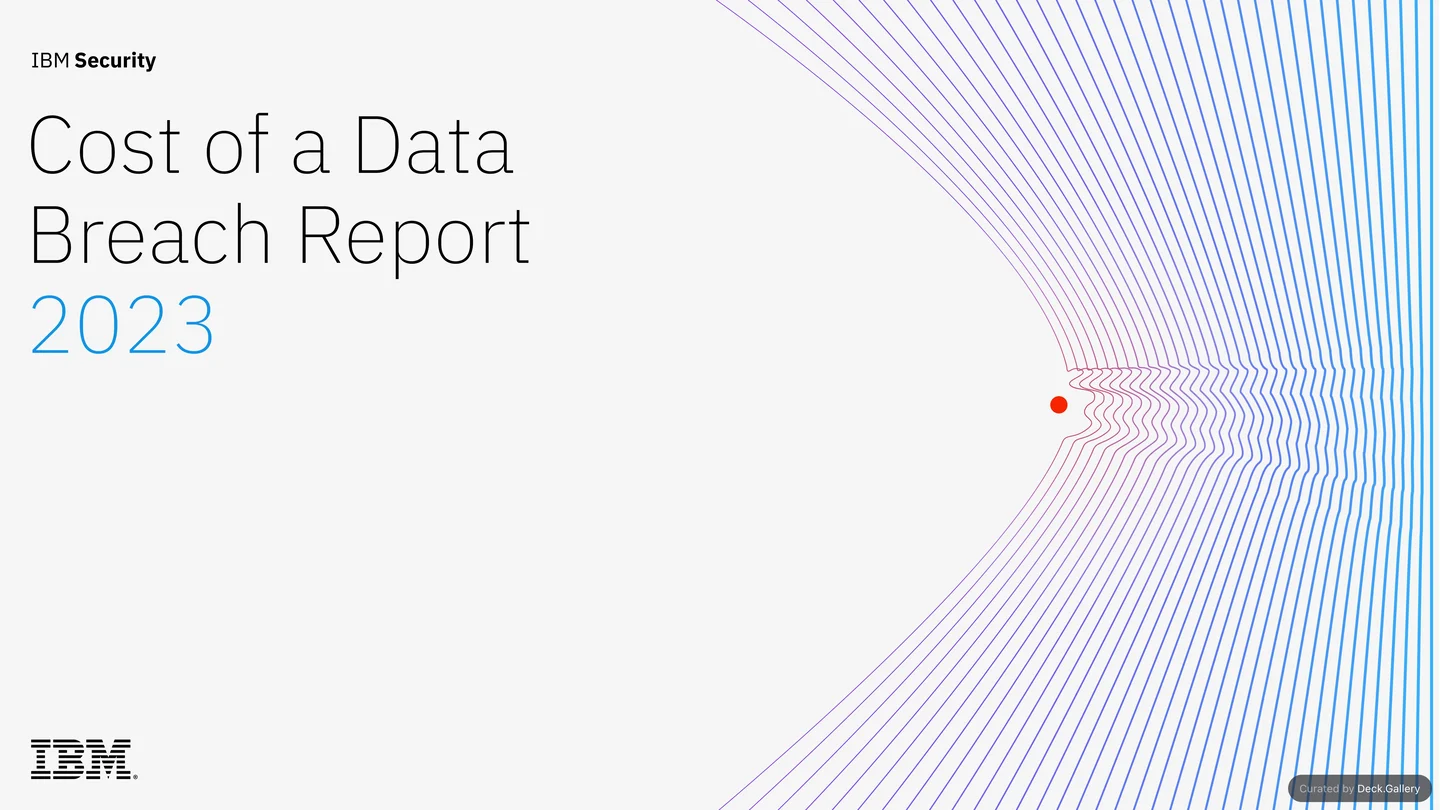
IBM Cost of a Data Breach Report 2023: Deck Breakdown
Most decks are pitches. The IBM Cost of a Data Breach Report 2023 is a different animal: a research artifact whose job is to be cited. It's the 18th annual edition of the same study. 78 slides. 553 organizations across 16 countries. The reason it exists is so a CISO can put a number in a board deck the following week. The argument it has to make is "this number is credible," not "buy this thing." That changes the whole structure.

The headline result is on slide 5: the global average breach cost reached USD 4.45M in 2023, a 2.3% year-over-year increase. Healthcare hit USD 10.93M (slide 13). The US averaged USD 9.48M for the 13th consecutive year (slide 11). 82% of breaches involved cloud environments (slide 43). Those numbers don't appear in the report once. They appear in the executive summary, then again in the topical deep-dive, then again in the methodology appendix. Repetition is the citation strategy.
Slides in this deck
The 78 slides fall into six sections:
- Cover and TOC (slides 1–2)
- Executive summary (slides 3–7), the part most readers stop at
- Complete findings, 18 themes (slides 8–61), the meat
- Recommendations (slides 62–66)
- Organization demographics (slides 67–70)
- Methodology, about, and legal (slides 71–78)
The complete findings section (slide 8 is the contents page for it) cycles through global highlights, attack vectors, identifying attacks, breach lifecycle, cost factors, ransomware, supply chain attacks, cloud breaches, mega breaches, security investments, AI/automation, incident response, threat intelligence, vulnerability management, ASM, and MSSPs. Each theme gets 2 to 4 slides: an opener that names the topic, then 1 to 3 data slides.
Three things that work
The executive summary front-loads cost mitigators
Slide 5 puts the global average breach cost alongside a counter-fact: organizations with extensive security AI and automation saved USD 1.76M on average and shortened the breach lifecycle by 108 days. Slide 7 does it again for DevSecOps (USD 1.68M saved) and IR planning (USD 1.49M). The first thing the report tells you is the size of the problem. The second thing is the size of the things that fix it. A reader who only looks at slides 1 through 7 still walks away with an action.
The 27-factor analysis earns its slide
Slide 28 plots 27 organizational factors by their impact on mean breach cost. Top mitigators (DevSecOps, employee training, IR planning, each shaving roughly USD 200–250k) on the left. Top amplifiers (security skills shortage, system complexity, noncompliance) on the right. It's the most quoted page from any IBM Cost of a Data Breach Report year-on-year, and it earns the spot: a single chart that tells a security buyer where their money should go. The next two slides (29, 30) deepen the top three on each side.
The methodology defends the number
Most reports treat methodology as a footnote. This one gives it eight slides (71–78). It explicitly labels the study limitations on slide 75: nonstatistical sampling frame, possible bias toward mature security programs, untested nonresponse bias, currency conversion choices tied to March 31, 2023 exchange rates. It explains that activity-based costing was used across four cost categories with a Monte Carlo simulation of 250,000 trials underpinning the mega-breach modeling. When the USD 4.45M number gets quoted in a board meeting, the methodology is what makes it defensible.
Three things to consider
Recommendations get five slides; product gets one
The recommendations section (62–66) bundles into four advice areas: secure SDLC, hybrid-cloud data protection, AI and automation, resiliency and IR. It reads cleanly. Then slide 77, titled "Take the next steps," lists nine IBM Security offerings as bullet points. A research report whose credibility depends on independence from a product menu probably wants more daylight between the analytic recommendations on slide 66 and the product CTA on slide 77. As laid out, they read as continuous.
No single-page TL;DR slide
Slides 5–7 are the executive summary, but they're three slides. A board-ready single slide, a table or chart with the five numbers worth quoting, would be the most-screenshotted page in the report. Years two through eighteen of an annual report are an opportunity to develop one canonical slide that anchors year-over-year reads. This year doesn't have one.
The deep-dive section is long
54 slides of complete findings is enough to lose a reader between software supply chain attacks (slide 37) and risk-based vulnerability management (slide 58). The 18 themes are sequenced cost-impact first, mitigation second. A reader using the report as reference probably wants the section index from slide 8 repeated as a header on every theme opener. The opener slides don't carry section context, so flipping mid-document loses orientation.
Key slides
Slide 14: mean time to identify and contain
Open this slide with membership
Mean time to identify (MTTI) was 204 days. Mean time to contain (MTTC) was 73 days. Combined: 277 days (slide 14). This is the operational number that anchors most of the downstream cost analysis. Breaches over 200 days cost USD 1.02M more than breaches under 200 days (slide 26).
Slide 28: the 27 cost factors
Open this slide with membership
The defining chart of this year's edition. Twenty-seven factors plotted by USD impact. One image, one decision tree for a security investment review.
Slide 52: AI adoption levels and breach costs
Open this slide with membership
61% of organizations use some security AI or automation. Extensive users averaged USD 3.60M per breach. Non-users averaged USD 5.36M, a gap of about USD 1.76M (slide 52). This is the slide most likely to be quoted through 2024, because it maps cleanly to a budget decision.
Takeaway
A pitch deck argues by narrative: problem, solution, evidence, ask. A research report argues by repetition. The same numbers, presented in successively more granular contexts, defended by methodology, ringed by limitations. IBM's 2023 edition shows the form working. USD 4.45M lands on slide 5, gets unpacked across 18 themed deep-dives, then gets defended by an unusually long methodology section, and emerges on the other side as a number that's quotable.