Boiler Room Audience Report 2025: 31-Slide Deck Breakdown
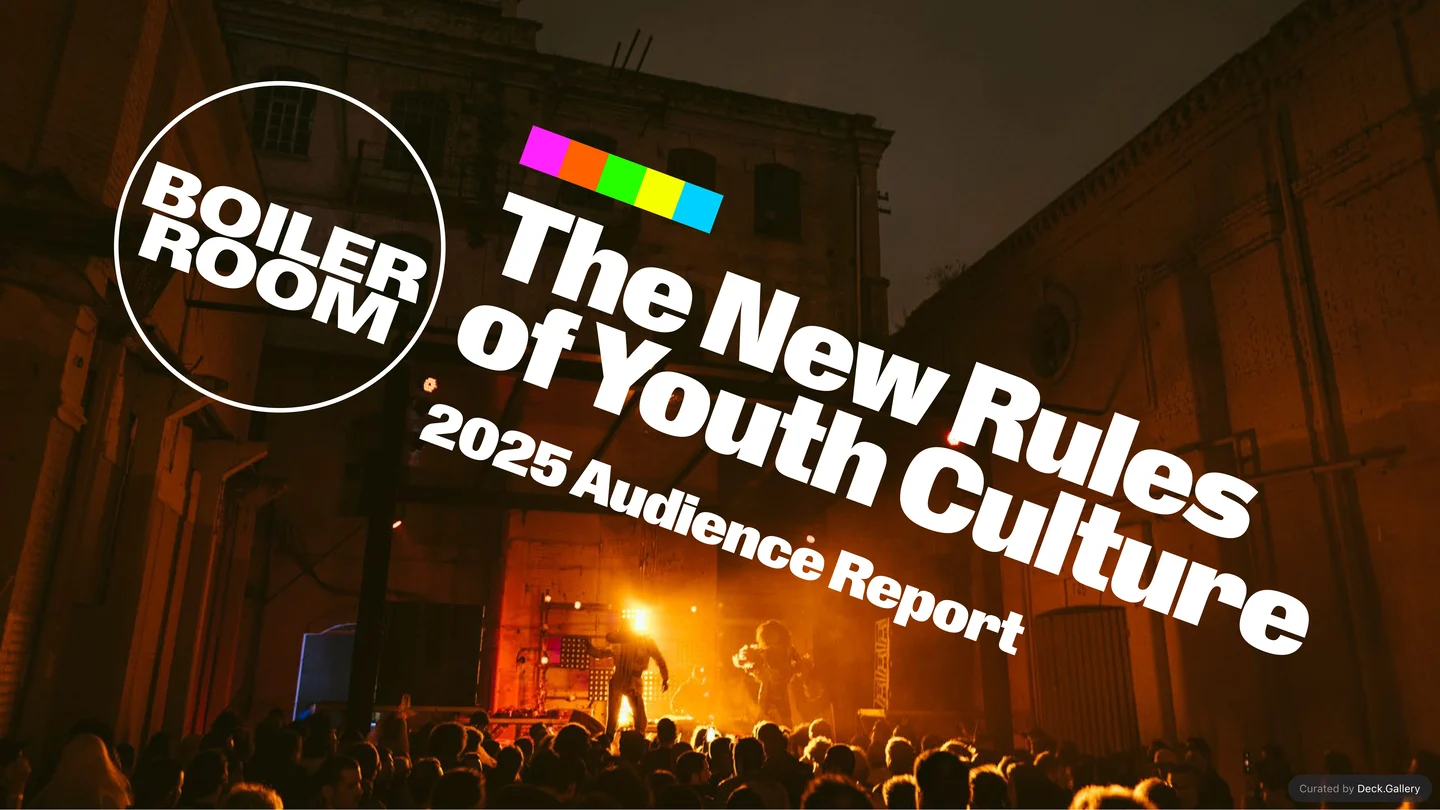
A media brand's audience report is, structurally, an advertising rate card with research stapled to the front. The job is to convince a brand planner that this audience is worth paying to reach. The Boiler Room Audience Report 2025, 31 slides drawn from 8,300 respondents aged 18 to 34, does that job in an unusual way. It doesn't claim the audience is average. It claims they're a tastemaker subculture, and uses the gap between Boiler Room data and "peer" data as the credential.

The headline argument: youth culture is actively reshaping the rules, not passively consuming them. Slide 2 sets up the thesis. Slide 4 names the five themes the rest of the deck unpacks: rooted in the collective, the new mindfulness, technological skepticism, spending where it matters, finding resilience in purpose. Each theme then gets a section opener, two or three data slides, and a pull-quote slide from a named voice.
Slides in this deck
Five themed sections, plus an opener and a closer:
- Setup (slides 1–4): cover, thesis, methodology, five themes
- Rooted in the collective (5–8): identity, community, locality
- The new mindfulness (9–13): wellbeing, mindful indulgence, clubbing with intention
- Technological skepticism (14–22): social-media pressure, AI fears, IRL over online
- Spending where it matters (23–25): financial pressure, conscious spending, tastemakers
- Finding resilience in purpose (26–29): activism, radical buoyancy, real-world trust
- Closer (30–31): 10-point summary, cultural blueprint
Three things that work
The five-theme spine is named once and never rebuilt
Slide 4 names the five themes. From there on, every section opener is one of those five names enlarged. The deck never re-explains its structure or re-orients the reader. A research report that doesn't trust its TOC tends to bloat with "as we discussed earlier" recaps. This one trusts you to remember slide 4.
Comparing-to-peers framing turns audience data into a credential
The most quotable move in the report is the comparison construction. Slide 14: "89% of Boiler Room's audience uses Instagram compared to 75% of peers." Slide 17: "80% worried about deep fakes compared to 63% of peers." Slide 19: "71% see digital as a barrier to engagement."
The Boiler Room audience gets positioned as a forward edge, not as representative of all 18–34-year-olds. More online, more skeptical of online, more committed to IRL. For a brand planner, that's worth more than a generic Gen-Z report, because the gap itself is the story.
Quote slides act as theme dividers
Slide 7, slide 13, slide 18, and slide 21 are quote slides from named cultural voices: Andreea Magdalina, Amar Ediriwira, Matas Petrikas. Each one breaks the rhythm of the data slides. The quote isn't supporting evidence so much as a pacing device. Number, number, voice, number. The structure is built around attention.
Three things to consider
No methodology slide upfront
Slide 3 names the sample (8,300 respondents, 18 to 34, global markets) but doesn't carry sampling frame, survey instrument, or fieldwork dates. The IBM Cost of a Data Breach Report puts eight slides of methodology in the back. Boiler Room's report puts one paragraph on slide 3 and moves on. For a media brand selling against the audience, the absence is a small bet that the brand-planner reader trusts Boiler Room enough not to ask for the survey instrument. It also means a third party can't easily cite this report the way they can cite IBM's.
The spending section is light on numbers
The deck names "spending where it matters" as one of its five themes (slides 23–25), but the data is thinner here than in the technological-skepticism section. Slide 24 gestures at financial pressure and conscious spending without quantifying. For a deck whose readers are brand planners deciding where to spend ad budget, this is the section where harder numbers would have done the most work.
The brand voice softens the data
The body copy is poetic: "rooted in the collective," "radical buoyancy," "cultural blueprint." It reads like a manifesto. The numbers underneath are doing real work (72% prefer physical events, 61% avoid social media recommendations, 57% buy physical music; see slide 16), but the framing language slows them down. A planner skimming the deck might come away with the vibe and miss the actionable percentages. The IBM convention of putting the headline number first and the framing second is a different bet.
Key slides
Slide 4: the five themes

The spine of the deck. Everything afterward refers back here.
Slide 19: IRL over online
Open this slide with membership
53% of the 18-to-34 audience value IRL communities more than online ones. 71% see digital as a barrier to engagement. This is the single stat a brand planner takes away from the report: the argument for sponsoring a Boiler Room event over running a programmatic campaign, in one number.
Slide 28: radical buoyancy
Open this slide with membership
The most-quotable phrase in the deck. It names what cohort behavior looks like in 2025: prioritizing music, experiences, and culture over traditional financial goals despite real pressure.
Slide 30: audience in 10 points
Open this slide with membership
The board-ready summary slide. Ten points, screenshot-shaped. Whatever else gets remembered from the report, this is the page that gets pasted into a media plan.
Takeaway
The most interesting structural choice in the Boiler Room report is the comparison-to-peers construction. Most audience-research decks lead with "our audience is huge" or "our audience is young." This one leads with "our audience is ahead." The data work is real but secondary. The comparison frame is what turns a survey into a sales document.
Read next: the trend reports roundup compares six more reports in this genre by the evidence each one runs on, from Accenture's 24,295-person survey to The RealReal's marketplace data.