The State of Social: A Trend Report Built as a Manifesto
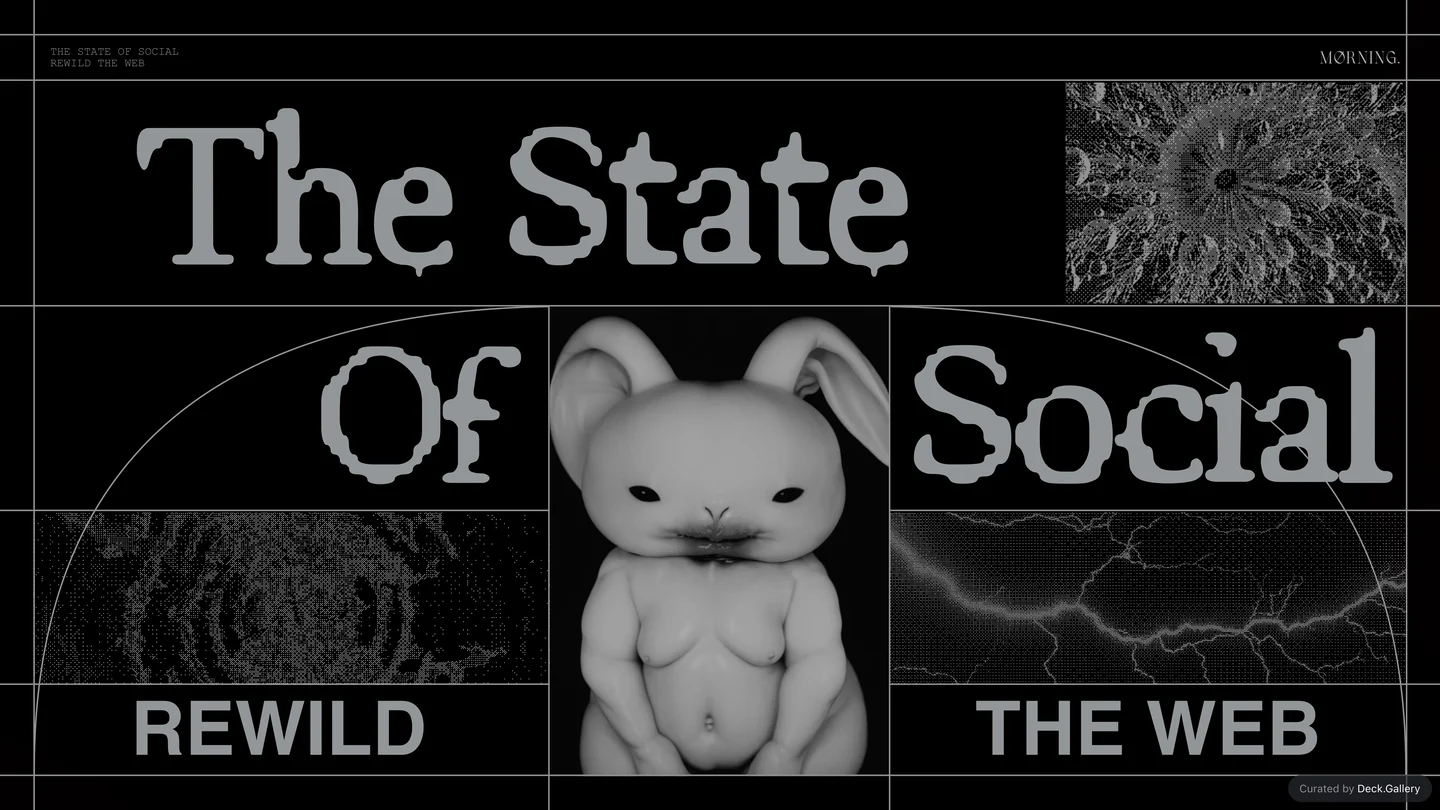
The State of Social: Rewild the Web is a 75-slide trend report from Morning., a creative studio, and it reads less like research and more like a position paper with citations. The argument: algorithmic feeds have domesticated the web into echo chambers and rage bait, and brands should respond by "rewilding," meaning smaller communities, weirder output, and fewer, better posts.
Open this slide with membership
How the deck is structured
The report opens with a diagnosis (algorithmic black holes, feed fatigue, trolling as promotion), names its method on slide 8 (digital ethnography, cultural audits, data mining, a global "shadow committee"), then builds a four-part framework: Random, Underground, Brutalist, Demystified. Part two turns the framework into a playbook with case studies (Jacquemus, Skims, Gentle Monster, Marc Jacobs, Alexis Bittar) and ends with an index, team credits, and eight pages of image attributions.
What works in the State of Social report
The shadow committee is a method you can picture
Most trend reports cite "proprietary research." Slide 9 describes a distributed committee of tastemakers acting as on-the-ground sensors, and slide 10 lists ten of them with roles and cities: London, Berlin, Hong Kong, Jo'burg, São Paulo, New York. Naming the sensors makes the ethnography checkable in a way an anonymous panel isn't, and it doubles as the report's credibility slide: this studio's product is knowing people the reader doesn't.
Anonymous sources say the quiet part
The strongest evidence in the deck is testimony no one would attach a name to. An anonymous London artist describes leaving accusatory comments on major fashion accounts to redirect attention to their own work. Another slide documents political Instagram communities following opponents on purpose because arguments drive reach. Trend reports usually quote executives being optimistic. Quoting practitioners admitting to tactics is what makes the outrage-economy section land.
The framework gets applied, not just declared
Slide 30 states the four rewilding principles; slides 63 and 64 then run Jacquemus and Skims through the same four pillars, one brand per slide, same grid. A framework demonstrated twice on real brands is worth more than a framework asserted once, and the parallel layout invites the reader to run their own brand through it as a third row.
The credits pages are the thesis in practice
Slides 68 through 75, more than a tenth of the deck, are image attributions: creator handles, Reddit posts, photographers, meme accounts. For a report arguing that culture comes from niche creators rather than platforms, crediting every screenshot is the argument enacted. It's also rare; most decks in this category lift screenshots silently.
What to consider
The anonymity cuts both ways. The Berlin cultural commentator and the London artist make the deck feel wired-in, but none of the scene-level claims can be verified, and the reader is trusting Morning.'s sourcing entirely. The named, checkable quotes (Molly Jong-Fast on rage farming, Yancey Strickler's dark forest metaphor) are borrowed from published writing rather than original interviews.
There's no quantitative baseline. The report claims mass reach is declining and cosy-web spaces are growing, and offers no numbers for either. Compare the Boiler Room Audience Report, which makes a similar culture-first argument but anchors it in survey data.
The prescription is also easier for some readers than others. "Post less, build lore, embrace chaos" is actionable for a fashion house with a strong creative director. Slide 47's thought experiment, a brand that communicates once per year, is a sharp provocation and a hard sell to anyone with a quarterly target.
The takeaway
The State of Social works because the deck behaves like the internet it describes: theatrical section openers, scene gossip, meme-density, and a bibliography of creators. The useful pages are the method (8 to 10), the framework and its applications (30 to 31, 63 to 64), and the cosy-web section (52 to 56), which is the best short explanation in the gallery of where audiences went when they left public feeds.
Browse the full State of Social report or explore more report decks.
Read next: the trend reports roundup compares this deck's ethnography against five other reports that earn their forecasts with survey panels, marketplace data, and platform telemetry.